
E-2 Investor Visas for British Citizens

British entrepreneurs who want to do business in the world’s largest economy are increasingly taking advantage of a visa program that allows them to own and/or invest in a U.S. business while living in the United States on a long-term basis.
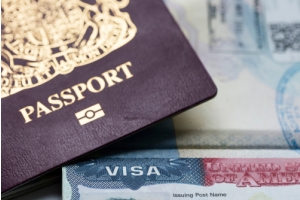
The E-2 (Treaty Investor) is a renewable non-immigrant visa allowing entrepreneurs from the United Kingdom to invest in a U.S. business and move to the United States to “develop and direct the operations of an enterprise.” {A similar program, the E-1 (Treaty Trade) visa, applies to businesses conducting international trade and commerce with the United States.} The E-2 allows British investors to live in the United States for an initial period of five years. It can be renewed as long as the business continues and the applicants remain in the country.
The treaty programs are not designed as a path to U.S. citizenship (like the EB-5 visa is). They provide a temporary visa that allows British citizens to live in the United States while maintaining their British residency. The U.K. and the U.S. were the first two countries to sign this type of treaty in 1815. Today more than 70 countries have E-1 and E-2 visa-enabling trade treaties with the United States.
The number of British citizens obtaining E-1 and E-2 visas has continued to climb over the past five years. According to the U.S. State Department, there were more than 47,000 investor visas issued globally in fiscal 2018, with 6.17 percent issued to British nationals. Previously, Great Britain accounted for 6.01 percent in 2017 and 6.09 percent in 2016. The United Kingdom also ranked fifth among E-2 visa issuance countries in 2018 with 2,740 U.S. visas. Compared to other programs, the E-2 carries a high approval rate that typically exceeds 90 percent, making it an attractive option for British investors.
Opportunities in the Southeast United States
Many British E-2 visa holders relocate to the Sun Belt –15 states spanning the southern third of the United States in a path from Florida to California. Generally located on or near the Gulf of Mexico, the Sun Belt also includes Alabama, Arizona, Georgia, Louisiana, Mississippi, New Mexico, Nevada, North Carolina, South Carolina, Texas, and Utah. The region’s warm weather, natural beauty, and abundant resources attract retirees and young professionals from Northern and Midwestern states, as well as immigrants, expats, and visitors from Great Britain, continental Europe, Asia-Pacific, and Latin America. The numerous military bases throughout the Sun Belt are sources of local economic activities, and are popular retirement destinations for former servicemen and servicewomen.
The Sun Belt has been the fastest growing region in the United States for decades, both in terms of population and economic indicators. The region includes 22 metropolitan areas with more than one million residents. Those cities added record numbers of both younger and older residents during the 2010s, contributing almost half the population growth in the United States.
Five of the 10 states that Forbes magazine ranked as the best for business in 2020 are located in the Southeast, and the top seven are part of the Sun Belt (https://www.forbes.com/best-states-for-business/list/#tab:overall). North Carolina was rated the top U.S. state for business for the third year in a row. Texas ranked second, followed by Utah, Virginia, Florida, Georgia, and Tennessee. The Southeast also includes what Forbes termed the “Southern Taxpayer Safe Space” after Florida, Georgia, South Carolina, and Tennessee elected governors in 2019 who pledged not to increase taxes during their terms. Those states also contain some of the fastest growing cities in the country (such as Atlanta, Nashville, Charleston, Greenville, Miami, and Orlando) and have drawn thousands of new residents from higher-tax states.
While the sunny, populous states of California and Florida are well known around the world as centers of economic and tourism growth, there are plentiful opportunities to invest throughout the Southeast. Booming areas that are often overlooked by investors include:
- Coastal Georgia, home to the Port of Savannah, the largest terminal container port in the United States.
- The Research Triangle in North Carolina, a technology startup hotbed.
- Texas, which boasts the second largest state economy in the country and -- if it were a country -- the tenth largest GDP in the world (larger than Canada or South Korea).
- Birmingham, Alabama, and Nashville, Tennessee, which have landed on numerous “Top 10” lists due to their diverse, bustling economies.
- Atlanta, Georgia, home to the world’s busiest airport and the headquarters of seven Fortune 100 companies.
- The mountains of North Carolina, North Georgia, and Tennessee, where the Southern Appalachians offer a variety of growth opportunities in tourism and industry.
- The Gulf Coast region of southern Mississippi and Alabama.
The region’s maintains strong ties to the United Kingdom (which date back to Colonial times) can help British newcomers feel more at home. Southern hospitality is more than a cliché: the welcome mat is always out, and the South becomes more culturally diverse each year. There are British pubs, tea houses, soccer and cricket teams, Scottish Highlander games, and cultural sites. Local British expat groups are active in many cities. Even the BBC has created a list of the Top 10 British aspects of numerous major U.S. cities, which is available at https://www.bbcamerica.com/anglophenia/2014/01/10-british-things-u-s-city.
The British government maintains a strong presence in the Southeast. Great Britain has general consulates in Miami, Houston, and Atlanta (https://www.gov.uk/world/organisations/british-consulate-general-atlanta). In 2017, a new trade office opened in Raleigh, North Carolina. The U.K. Government Office there promotes business, economic, and political ties.
Qualifications for E-2 Visa
To qualify for an E-2 visa, the applicant must be a British citizen and resident making a “substantial” investment in a U.S. enterprise. While the definition of “substantial” varies by industry and country of origin, the rule of thumb for British citizens is investing at least $200,000 in an existing business. For start-ups, the investment must be large enough to launch and operate the new business. E-2 visas are also available for certain non-investor employees of the business who have specialized, executive or supervisory skills. Spouses and minor children of applicants may also apply for E-2 derivative visas.
Other basic requirements for British citizens applying for an E-2 visa include:
- The “substantial” requirement generally means owning and/or controlling at least 50 percent of the invested business.
- The investment must be an operating enterprise or a new business about to launch. Undeveloped land or money in a bank account for future activities does not qualify.
- The enterprise cannot be “marginal,” meaning the business must generate significant income or make a significant economic impact in the United States.
- The investor must control the funds to be invested, and that money must be at risk from a commercial standpoint. Loans secured against the enterprise’s assets are not allowed (although a personal mortgage or equity line is permitted).
- The investor must come to the United States to direct the enterprise, and demonstrate prior experience in the business sector or as an entrepreneur.
British citizens should apply in person at the U.S. Embassy in London. Detailed instructions and forms for applying for the E-2 are available online at https://uk.usembassy.gov/visas/treaty-trader-or-treaty-investor/how-to-apply. The typical turnaround time for U.K. applications is around four months. Additional information on E-2 is also available from U.S. Immigration at https://www.uscis.gov/working-in-the-united-states/temporary-workers/e-2-treaty-investors.
Assisting Britons with the E-2 Visa Process
At British Passport Pro, we offer a number of services to help British citizens plan for and obtain an E-2 visa. Our staff can help applicants create marketing plans; search for businesses that are eligible for E-2; network with brokers who specialize in British expats and E-2 investments; and guide applicants with assembling the required documentation. For more information or get started on the E-2 process, you can schedule a telephone call with our experienced Atlanta-based team through our website, http://www.britishpassportpro.com/