
What Are the Benefits of British Citizenship?

A growing number of British citizens in the United States have begun exploring dual citizenship for their children born outside the United Kingdom.
While there are no official statistics on the exact number of dual citizens in the United States, interest among U.S. residents with family or cultural ties to other countries has grown in recent months. Recent media reports cited industry consultants who are now seeing higher-than-usual inquiries into the requirements and process for obtaining dual citizenship. Statistics from Google Trends indicate a record number of Americans researched their options over the summer. A number of reasons were given for the growing interest, including health concerns about the continuing COVID-19 pandemic; uneasiness over U.S. political and civil unrest; obtaining a second passport to make international travel easier; the ability to live aboard without visa restrictions; or simply desiring to establish closer cultural links with one’s country of origin.
“At its most basic level, dual or multiple citizenship involves the simultaneous holding of more than one citizenship or nationality,” according to the non-profit Center for Immigration Studies in Washington, D.C. “A person can have each, or many, of the rights and responsibilities that adhere to a citizen in all of the several countries in which he or she is a citizen, regardless of length of time or actual residence in a country, geographical proximity, or the nature of his or her economic, cultural, or political ties.”
More than 40 countries allow dual citizenship, including the United States and Great Britain. According to the U.K. government, those who are already British citizens can apply for foreign citizenship without forfeiting their UK status. “In some countries, a married person is automatically counted as having their partner’s nationality,” the government’s website entry on dual citizenship (https://www.gov.uk/dual-citizenship) states. “Children may also automatically have a parent’s nationality even if they were born abroad.”
Benefits of British Citizenship
While the requirements for obtaining dual U.S.-U.K. citizenship can be complex, the benefits of British citizenship often outweigh the hassles and other disadvantages of dual citizenship.
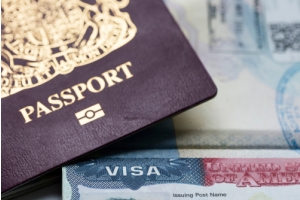
The most obvious benefit is the ability to obtain a U.K. passport. Once British citizenship is granted, you can apply for a U.K. passport without forfeiting your U.S. passport. The U.K. passport allows you unrestricted entry to the United Kingdom, as you are no longer constrained by immigration controls. (Most UK airports have ePassport gates where you can enter by using automated machines rather than deal with a live agent.) When you return to the United States, you can use your U.S. passport and avoid immigration.
Freedom of movement to other parts of the British Commonwealth, such as Australia, Canada, and New Zealand, are also easier as no visa is required. Outside the Commonwealth, there are also some countries where you can travel with the U.K. passport without encountering certain restrictions on U.S. passport holders in those countries, such as visa/reciprocity fees.
Other benefits of British citizenship include:
- The right to permanently live within the U.K., including owning property, marrying, and opening a bank account.
- Employment in the U.K. without work permit and similar restrictions. Citizens can also access government unemployment benefits and job search services.
- Education at U.K. rather than international rates (maybe). Generally, students have to be U.K. residents for at least three years to avoid paying international rates. However, each university decides whether to charge international fees on a case-by-case basis. For example, those who can prove they were living in the United States because of their parents’ jobs, they can still quality for the lower UK tuition rates.
- Access to U.K. student loans.
- No student visa requirements.
- Free medical care through the U.K. Health Service.
- Other social programs.
- The right to vote and run for office within the United Kingdom.
- Obtaining help from a British embassy when you are overseas.
- Ability to live in either the United Kingdom and the United States (or both), and commute easily between the two countries.
Another current benefit is that British citizenship allows you travel and work anywhere within the European Union without restrictions. However, with Britain in the process of leaving the EU, some (if not all) of those rights will be diminished once Brexit is completed in mid-2021.
However, there are also disadvantages to holding citizenships in two or more countries that should be considered. Those include the possibility of double taxation; limited consular help in some situations; and often not being eligible for special U.S. security clearances required for certain government jobs.
The cost of education may or may not be better outside the United States. While the U.K. government caps tuition for resident undergraduate students at 9,250 pounds (about $13,250), international tuition is not capped. Thus, depending on the individual universities being compared, tuition may be higher in the United Kingdom than in the United States. Living costs and other expenses may also be higher. As the cost of higher education is rising around the world, research is required to determine which school in which country would be less expensive.
Assistance for the UK Citizenship Process
British Passport Pro has considerable experience helping British citizens who want to explore the detailed requirements for obtaining British citizenship for their family members. For more information, you can schedule a telephone call with our experienced Atlanta-based team through our website: https://www.britishpassportpro.com/.